Studio Design
TECHNIQUE & PROFESSIONNEL STANDARD
Last month we briefly summarized some of the issues concerning acoustic criteria and acoustic design as they relate to audio production suites for the broadcasting industry.
In that discussion, we determined that finished design solutions integrate two fundamental acoustic categories (sound transfer acoustics and internal room acoustics) in creative ways. It is the job of the room designer to accommodate user ergonomics and room layout requirements, while maintaining these standards. We now discuss these tasks in more detail.
________________________________________
Ergonomics
Ergonomics is the room’s architectural program — how we arrange equipment, furniture and other elements in our rooms, and how these elements affect the usefulness and comfort level of the environment. It is also important in audio production suites to consider how these arrangements affect and are affected by acoustics. Remember, our goal is to have the most accurate acoustic response possible in the critical listening position. Acoustic design is then applied to accommodate these requirements. The old architectural anthem “Form follows function” is especially true for audio production environments.
__________________________________________
Control room layouts
Audio control rooms can be categorized into four room layout configurations: cockpit style (symmetrical arrangement), cockpit style (asymmetrical arrangement), railroad layout (symmetrical) and railroad layout (asymmetrical).
In each of these configurations, there will be variations resulting from changes in speaker size and mounting, glass (viewing to studios and/or outdoors), egress in and out of the room, 5.1 surround requirements, etc.
Figure 1b. In Carter Burwell’s film mixing and composing facility, rear corner cabinets house equipment, keeping the space directly behind the listening position clear.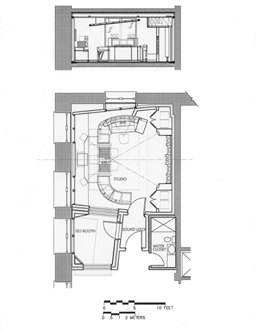
Cockpit style (symmetrical arrangement). The room’s acoustic centerline (the axis between the primary stereo mixing speakers) will be centered on a mixing/production console or workstation. This axis is aligned with the room’s architectural (physical) centerline. There is really no reason for this not to happen. All other equipment – processing devices, composing gear (ie. keyboard), etc. – will be arranged on either side of this position, as symmetrically as possible. In this configuration, there is no equipment or furniture directly behind the listening position. The acoustic advantage of this layout is that the equipment and furniture are not in conflict with speaker reflection patterns. On more than one occasion, we have seen a perfectly well-designed room be acoustically compromised by one large piece of equipment (ie. tall equipment rack) that created a comb filter or harsh reflection for one speaker that was quite different than the other.
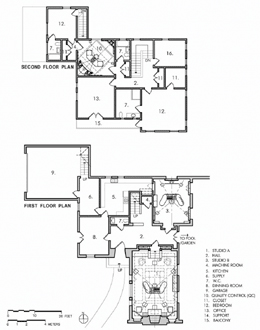
Both Mi Casa Multimedia in Hollywood and film composer Carter Burwell’s private production studio (see figures 1a and 1b) exhibit this type of layout. In Carter Burwell’s production studio, extensive equipment is housed in rear corner cabinets, but no equipment is directly behind the listening position. Mi Casa’s Studio A exhibits a near perfect symmetrical arrangement of equipment with no rear reflective furniture.
________________________________________________
_______________________________________________
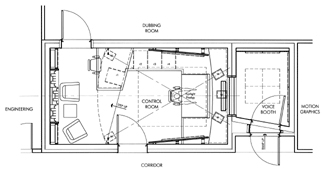
Figure 3. The floor plan for Berwyn Editorial reflects symmetry of room boundaries, even though its furniture layout is partially asymmetrical.
______________________________________________
.gif?timestamp=1277535968578)
Room design for audio facilities can be divided into four general categories, which vary slightly to meet the specific requirements of individual facilities. One possible configuration is a symmetrical arrangement of the cockpit style, as illustrated by Mi Casa Multimedia’s Studio A. Photos courtesy Robert Wolsch.
